Gita Patel
Life of PiGita Patel is Pi Patel’s mother and a largely secular presence in a family whose son is drawn toward religious life. The account defines her through contrasts: she is usually calm but can become fiercely distressed when her children are frightened; she treats religion with detachment but takes Pi’s spiritual curiosity seriously; and, as the family prepares to leave India, her attachment to home becomes more visible than the impatience of those already imagining themselves in Canada.
Family Life and Protective Instinct
Gita Patel’s place in the household is established partly by what is unusual. When Pi’s father calls the children together for an important lesson, Gita Patel is already in the living room. Pi notices her presence because the discipline of the children, like the tending of the animals, generally falls to his father. Her face is flushed, and her concern tells Pi that the occasion is serious before the lesson has even begun. She exchanges a glance with Ravi Patel as the family gathers, a small gesture that places her alongside her children in their apprehension.
Her protective instinct becomes unmistakable after Pi’s father arranges for the children to see a hungry tiger attack a goat. The goat leaps against the smooth cement wall of its cage; then the trapdoor opens and the tiger moves into the neighboring enclosure. Pi remembers the sound and terror of the scene, while remaining unsure whether the blood he recalls seeing was actually present then or added later to his memory. Gita Patel bundles the children away. Once outside, she is incensed, telling Pi’s father that the children will be scarred for life. Her voice trembles, tears are visible in her eyes, and Pi feels better at seeing that she, too, is shaken. Against her husband’s argument that the frightening demonstration might keep Pi from reaching through a cage to touch a tiger, Gita Patel’s response insists on the cost of making children learn through terror.
Religion and the Household’s Secular Temper
The family is described as anything but orthodox, and Gita Patel’s religious distance has a particular history: a Hindu upbringing and a Baptist education have, in Pi’s account, canceled one another out, leaving her serenely impious. She is not presented as hostile to religion. Rather, it is not a source of spiritual urgency for her. Her response to Pi’s early reading suggests a more open, unalarmed disposition. He reads comic books of the Ramayana and the Mahabharata, an illustrated children’s Bible, and other stories of the gods. Gita Patel suspects that he sees something different in these matters, but she does not challenge him about it.
That quiet allowance distinguishes her from Pi’s father, whose attention is directed toward the practical business of the zoo, and from Ravi Patel, who shows little interest in religion. Gita Patel neither converts Pi’s curiosity into a family project nor tries to shut it down. The result is not agreement but room: Pi’s interests can grow in a home where his mother remains personally detached from the beliefs that fascinate him.
Books and Pi’s Religious Questions
Reading is one of the clearest points of connection between Gita Patel and Pi. She is herself a big reader and is pleased to find him absorbed in a book, provided it is not naughty. When Pi asks about his religious interests, she first directs him to speak with his father; after learning that he has already done so, she lays down her book and looks toward the zoo before turning to the bookshelf. She reaches for a volume by Robert Louis Stevenson, a move Pi recognizes as her usual tactic. He tells her he has read that book three times, and her arm hovers toward another choice.
The exchange gives their relationship a lightly comic rhythm, but it also shows how Gita Patel approaches a subject she finds difficult to resolve. She offers a book rather than an immediate pronouncement. When she does address Pi’s beliefs directly, she says that a religious person must be Hindu, Christian, or Muslim, referring to what he heard on the esplanade. Pi argues that he can be all three. Gita Patel rejects his comparison between religious belonging and having two national passports: France and India are nations on earth, she says, so the analogy does not settle the question for her. The conversation records a real difference in outlook without turning it into a rupture. She questions Pi’s position, but the evidence of her earlier silence and continued engagement shows that his religious life remains something she is willing to hear about.
Leaving India
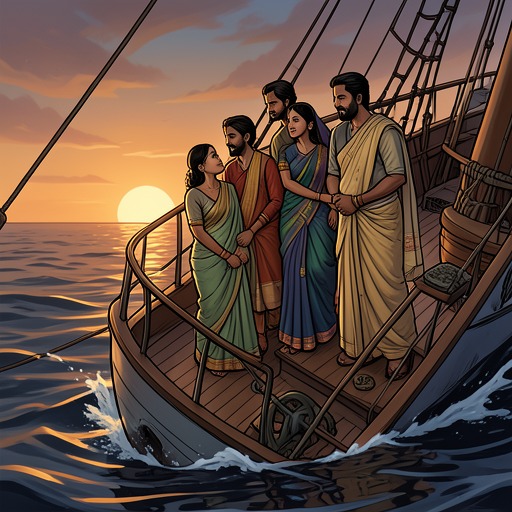
Gita Patel’s attachment to India comes into sharper view as the family prepares to emigrate. On June 21, 1977, they leave Madras aboard the Japanese cargo ship Tsimtsum. On their last day in Pondicherry, Pi says goodbye to friends and familiar people; Gita Patel wears her finest sari, with fresh jasmine in the hair folded back at the nape of her neck. Pi sees her as beautiful and sad. His description lingers on what she is leaving: the heat and monsoons, rice fields and the Cauvery River, coastlines and stone temples, familiar streets, friends, and known shopkeepers.
The difference between mother and son is expressed in their pace. Pi, though only sixteen, imagines himself among the men already hurrying toward a Canadian future; Gita Patel lingers. The day before departure, she earnestly asks whether they should buy a pack or two of cigarettes. Pi’s father answers that tobacco is available in Canada and reminds her that they do not smoke. The exchange is brief and practical, but it belongs to the same departure scene as her reluctance to leave: while the rest of the family turns toward what comes next, Gita Patel is still attending to the familiar world they are about to lose.
Narrative Role
Gita Patel is characterized less by a sustained account of her private thoughts than by her visible responses and by Pi’s retrospective interpretation of them. Her flushed face, tears, and anger make the consequences of the tiger lesson legible; her book offered from the shelf turns a difficult conversation toward the medium she knows; her finest sari and lingering farewell register the emotional weight of emigration. Across these scenes, she does not determine Pi’s choices, but she gives them a domestic setting in which fear can be protested, books can be shared, and religious difference can be discussed without erasing affection. Her departure from India also supplies a counterpoint to the family’s forward motion: the journey is not only a beginning for Pi, but a leave-taking for his mother.